- Details
- Written by: ACE Project
- Category: Resources
- Read Time: 16 mins

Foundations of Gravitational Waves:
Theory, Sources, and Detection
From linearised Einstein equations through laser interferometry, compact binary coalescences, stochastic backgrounds, and matched-filter data analysis across four structured modules with lectures, assignments, and computational notebooks.
This course bridges general relativity and observational gravitational-wave astronomy. Starting from the quadrupole formula and Peters (1964) orbital decay formalism, it progresses through LIGO/Virgo/KAGRA detector technology, the astrophysical zoo of GW sources — compact binaries, continuous wave emitters, stochastic backgrounds, and concludes with the Bayesian and matched-filter machinery used to extract signals from noise. The course is specifically designed for advanced undergraduates, postgraduate students, and researchers entering the field.
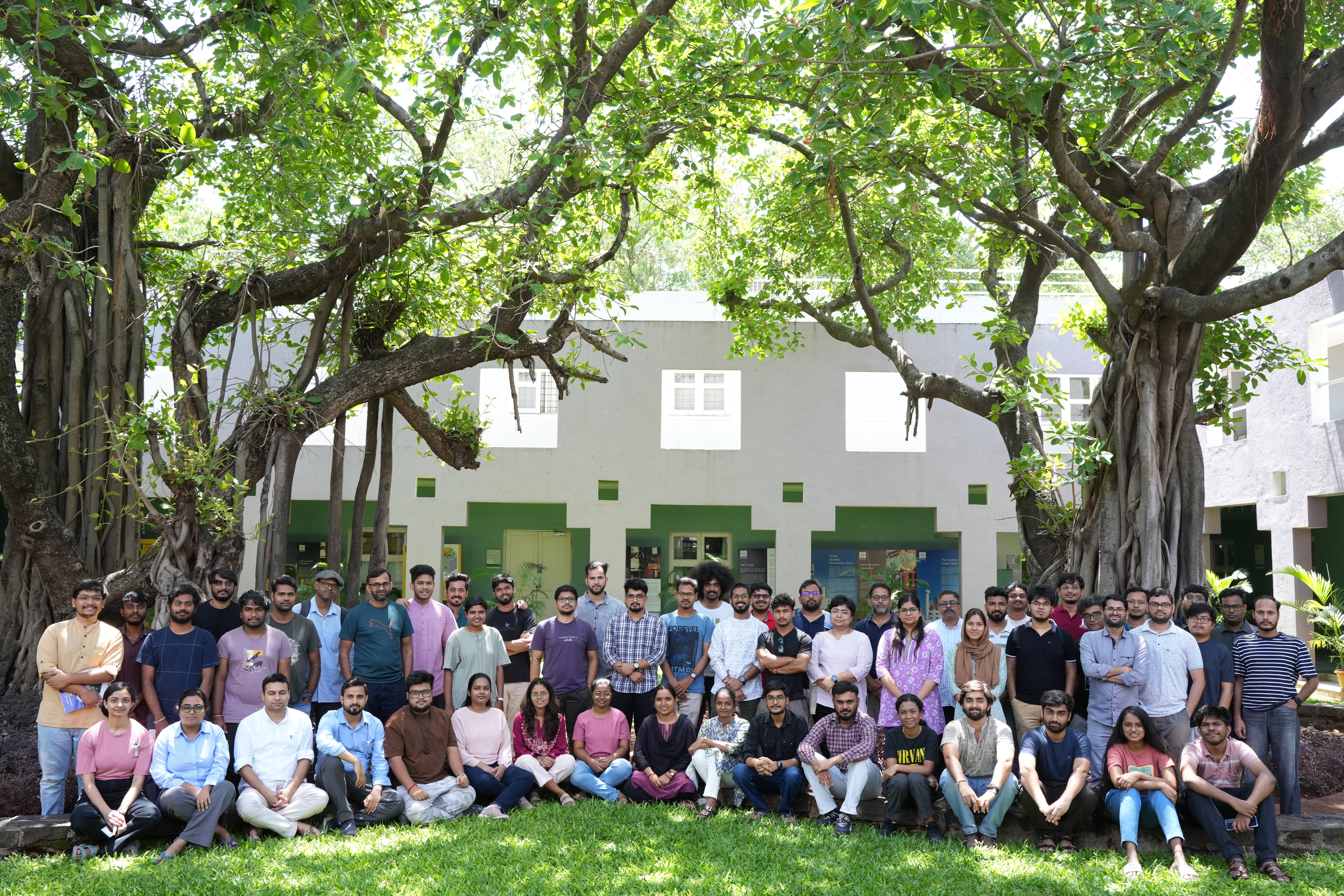
Meet the speakers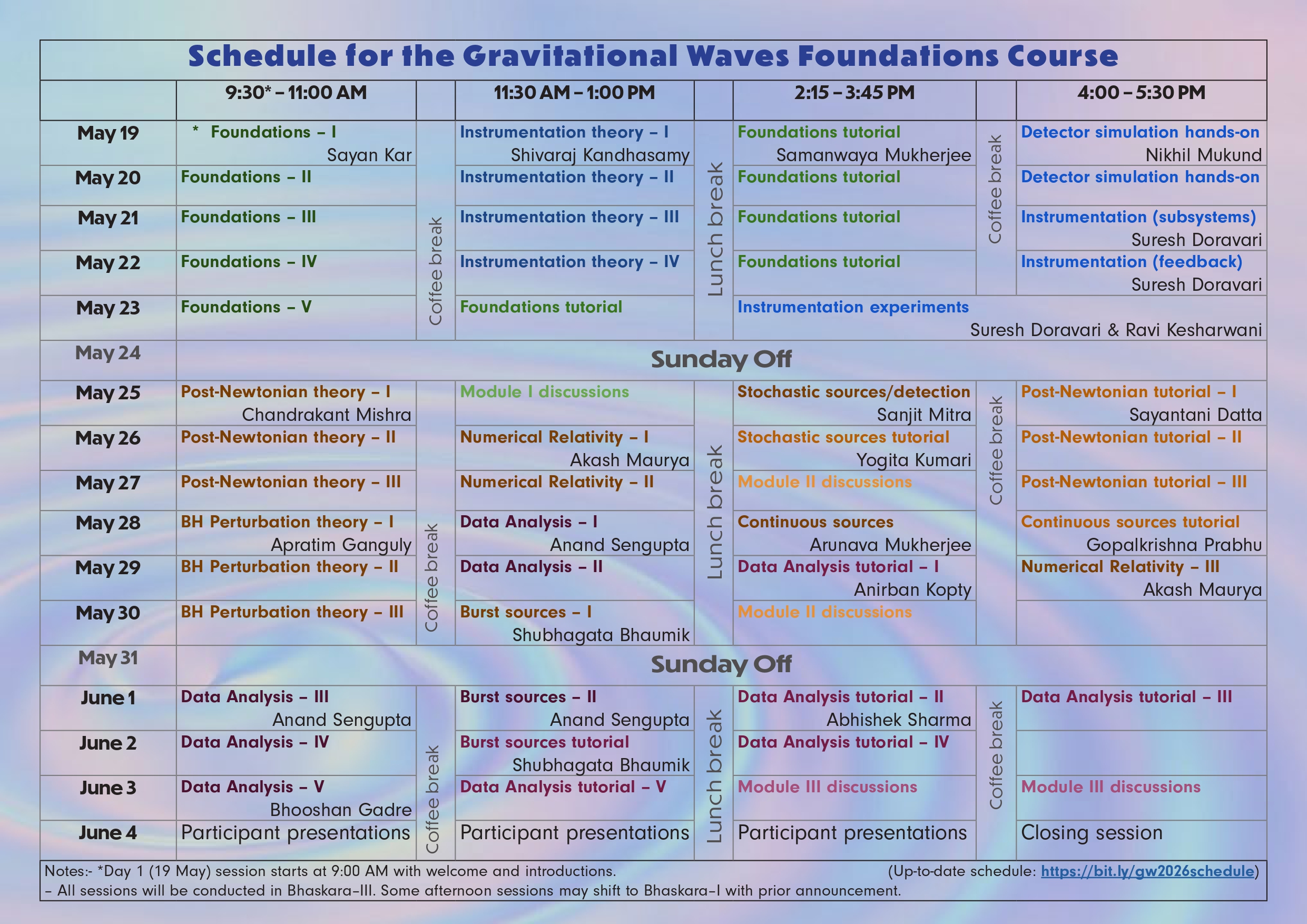
Modules
01Foundations of Gravitational Wave Theory▼
Lectures
Tutorials
Foundations Tutorial - I
Foundations Tutorial - II
Foundations Tutorial - III
Foundations Tutorial - IV
Foundations Tutorial - V
Tutorial Materials
Question sheets, Python & Mathematica notebooks, and datasets for this tutorial.
02Detection and Instrumentation▼
Detection
Lecture 2.1: Gravitational Wave Detection - I
Lecture 2.2: Gravitational Wave Detection - II
Lecture 2.3: Gravitational Wave Detection - III
Lecture 2.4: Gravitational Wave Detection - IV
Instrumentation
Lecture 2.5: Gravitational Wave Instrumentation - I
Lecture 2.6: Gravitational Wave Instrumentation - II
Tutorial
Instrumentation Experiments Tutorial
Optical Simulations using Finesse
Lecture 2.7: Optical Simulations using Finesse
Tutorial
Finesse Tutorial
Tutorial Materials
Question sheets, Python & Mathematica notebooks, and datasets for this tutorial.
03Sources and Modelling▼
Post-Newtonian Theory
Lecture 3.1: Post-Newtonian Theory - I
Lecture 3.2: Post-Newtonian Theory - II
Lecture 3.3: Post-Newtonian Theory - III
Tutorials
PN Theory - I
PN Theory - II
PN Theory - III
Tutorial Materials
Question sheets, Python & Mathematica notebooks, and datasets for this tutorial.
Numerical Relativity
Lecture 3.4: Numerical Relativity - I
Lecture 3.5: Numerical Relativity - II
Lecture 3.6: Numerical Relativity - III
BH Perturbation Theory
Lecture 3.7: Black Hole Perturbation Theory - I
Lecture 3.8: Black Hole Perturbation Theory - II
Lecture 3.9: Black Hole Perturbation Theory - III
Tutorial Materials
Question sheets, Python & Mathematica notebooks, and datasets for this tutorial.
Stochastic Backgrounds
Lecture 3.10: Stochastic Gravitational Wave Sources and Detection
Tutorials
Stochastic Sources Tutorial
Tutorial Materials
Question sheets, Python & Mathematica notebooks, and datasets for this tutorial.
Burst Sources
Lecture 3.11: Burst Sources - I
Lecture 3.12: Burst Sources - II
Tutorials
Burst Sources Tutorial
Tutorial Materials
Question sheets, Python & Mathematica notebooks, and datasets for this tutorial.
Continuous Sources
Lecture 3.13: Continuous Sources
Tutorials
Continuous Sources Tutorial
Tutorial Materials
Question sheets, Python & Mathematica notebooks, and datasets for this tutorial.
04Data Analysis▼
Lectures
Lecture 4.1: Data Analysis - I
Lecture 4.2: Data Analysis - II
Lecture 4.3: Data Analysis - III
Lecture 4.4: Data Analysis - IV
Lecture 4.5: Gravitational Wave Searches
Tutorials
Data Analysis Tutorial - I
Data Analysis Tutorial - II
Data Analysis Tutorial - III
Data Analysis Tutorial - IV
Data Analysis Tutorial - V
Tutorial Materials
Question sheets, Python & Mathematica notebooks, and datasets for this tutorial.
- Details
- Written by: ACE Project
- Category: Resources
- Read Time: 14 mins
A First Course in Astronomy and Astrophysics
This introductory course covers the foundations of astronomy and astrophysics across six structured modules — from the basic tools and techniques of observational astronomy, through stellar physics and evolution, to the large-scale structure of the Milky Way, galaxies, and the Universe as a whole. The course features hands-on activities alongside video lectures and problem sets, making it suitable for undergraduate students, university teachers, and anyone seeking a rigorous first encounter with modern astrophysics.
Meet the speakersVideo Lectures
01Introduction and Tools of Astronomy▼
Lecture 1.1: Multiwavelength astronomy & Positional astronomy
View Lecture Summary ▼
Lecture 1.2: Positional astronomy – I
View Lecture Summary ▼
Lecture 1.3: Positional astronomy – II
View Lecture Summary ▼
Lecture 1.4: Photometry
View Lecture Summary ▼
Lecture 1.5: Spectroscopy
View Lecture Summary ▼
Lecture 1.6: Observational tools and techniques - I
View Lecture Summary ▼
Lecture 1.7: Observational tools and techniques - II
View Lecture Summary ▼
02Hands-on Activities▼
Activity 2.1: Creating Color-Composites – I
View Activity Summary ▼
Activity 2.2: Creating Color-Composites – II
View Activity Summary ▼
Activity 2.3: Creating Color-Color diagrams
View Activity Summary ▼
Activity 2.4: Solar Rotation - I
View Activity Summary ▼
Activity 2.5: Solar Rotation - II
View Activity Summary ▼
Activity 2.6: Solar Rotation - III
View Activity Summary ▼
Activity 2.7: Solar Rotation - IV
View Activity Summary ▼
03Stellar Observations and Stellar Structure▼
Lecture 3.1: Stellar observations – I
View Lecture Summary ▼
Lecture 3.2: Stellar observations – II
View Lecture Summary ▼
Lecture 3.3: Hertzsprung-Russell diagram
View Lecture Summary ▼
Lecture 3.4: Stellar structure – I
View Lecture Summary ▼
Lecture 3.5: Stellar structure – II
View Lecture Summary ▼
04Stellar Evolution & End State of Stars▼
Lecture 4.1: Stellar evolution – I
View Lecture Summary ▼
Lecture 4.2: Stellar evolution – II
View Lecture Summary ▼
Lecture 4.3: Stellar evolution – III
View Lecture Summary ▼
Lecture 4.4: Stellar evolution – IV
View Lecture Summary ▼
Lecture 4.5: Stellar evolution – V
View Lecture Summary ▼
Lecture 4.6: Stellar evolution – VI
View Lecture Summary ▼
05Milky Way and Galaxies▼
Lecture 5.1: Galaxy morphology
View Lecture Summary ▼
Lecture 5.2: AGN and galaxy groups
View Lecture Summary ▼
Lecture 5.3: Galaxy groups and clusters
View Lecture Summary ▼
Lecture 5.4: The Milky Way galaxy
View Lecture Summary ▼
06Cosmology▼
Lecture 6.1: Cosmology - I
View Lecture Summary ▼
Lecture 6.2: Cosmology - II
View Lecture Summary ▼
Lecture 6.3: Cosmology - III
View Lecture Summary ▼
Lecture 6.4: Cosmology – Hands-on activity
View Lecture Summary ▼
Assignments
Data and Software Download
Online data and software for hands-on activities.
View data & software list ▼
1. Creating Color-Composites
Software
- This activity requires one software (installable on various operating systems). For Windows and Ubuntu (Linux), download the software program here.
- For other operating systems, download and follow the instructions here (use version 8.6).
Data
- The data needs to be downloaded from the HST Legacy archive. For convenience, one set of data for the Whirlpool Galaxy M51 is available here (all three data files need to be downloaded).
2. Color-Color Diagrams
- Data available here (all files need to be downloaded).
3. Solar Rotation using SDO Images
- Data available here (all files need to be downloaded).
- Details
- Written by: ACE Project
- Category: Resources
- Read Time: 2 mins
Meet the Speakers
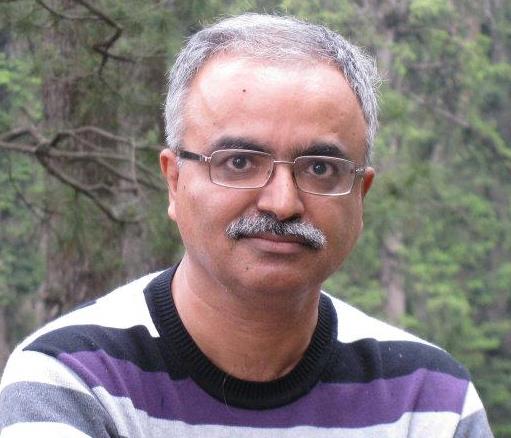
Tejinder Pal Singh
Tejinder Pal Singh is a theoretical physicist captivated by the intersections of classical gravity, quantum mechanics, and cosmology. After 33 years at TIFR Mumbai, he continues to explore foundational problems of quantum theory and gravity, focusing recently on the octonionic approach to unification.

Patrick Das Gupta
Patrick Das Gupta is a theoretical physicist and astrophysicist with work spanning general relativity, cosmology, quantum mechanics, and fast radio bursts. After 31 years at Delhi University, he remains a beloved educator known for clear, intuitive teaching.

Ashmita Das
Ashmita Das works at the intersection of semiclassical gravity, quantum fields in curved spacetime, and higher-dimensional particle physics. Her teaching emphasizes intuitive connections between geometry, quantum effects, and observable physics.

Apratim Ganguly
Apratim Ganguly is a computational physicist at IUCAA specialising in gravitational-wave data analysis, symbolic tensor calculus, and black hole perturbation theory. His tutorials bridge theory and practical computation.

Bhaswati Mandal
Bhaswati Mandal studies modified gravity, gravitational waves, and black hole physics at ISI Kolkata. She brings both research depth and strong teaching experience to the refresher course.

Anuj Mishra
Anuj Mishra (ICTS) specialises in gravitational waves, especially lensing and wave-optics effects. His practical experience with real detector data brings observational GR physics to the classroom.
- Details
- Written by: ACE Editor
- Category: Resources
- Read Time: 17 mins
General Relativity
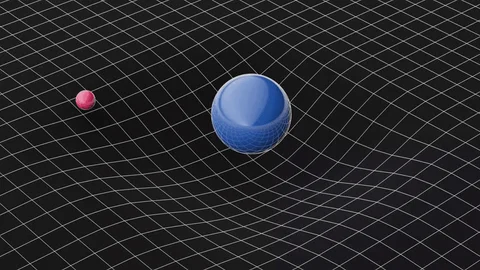
The following lectures were part of the two-week refresher course on General Relativity held at IUCAA, from 25 June to 4 July 2025. The course features two complementary tracks: Track A with a differential geometry approach to general relativity, including modern developments and conceptual connections with quantum theory, and Track B focusing on tensor calculus and the physical aspects of general relativity.
The course is ideal for university teachers, graduate students, and anyone seeking a structured, in-depth refresher in General Relativity.
Video Lectures
Track A — Prof. T. P. Singh▼
Lecture A1: History of gravitation
View Lecture Summary ▼
Lecture A2: Modern perspectives on gravity and quantum theory
View Lecture Summary ▼
Lecture A3: Uniformly accelerated observers – the Rindler coordinates
View Lecture Summary ▼
Lecture A4: Gravitation vs electromagnetism
View Lecture Summary ▼
Lecture A5: General relativity in the language of differential forms
View Lecture Summary ▼
Lecture A6: Differential forms and exterior calculus
View Lecture Summary ▼
Lecture A7: Connection 1-forms and Cartan structural equations
View Lecture Summary ▼
Lecture A8: Computing curvature using differential forms
View Lecture Summary ▼
Lecture A9: Motivating Einstein's equations and Weyl curvature
View Lecture Summary ▼
Lecture A10: Continuous gravitational collapse and black holes
View Lecture Summary ▼
Lecture A11: Formation of naked singularities
View Lecture Summary ▼
Track B — Prof. Patrick Das Gupta▼
Lecture B1: Inertial frames, good clocks and the equivalence principle
View Lecture Summary ▼
Lecture B2: Differential geometry – I
View Lecture Summary ▼
Lecture B3: Differential geometry – II
View Lecture Summary ▼
Lecture B4: Differential geometry – III
View Lecture Summary ▼
Lecture B5: Tensor calculus and the Newtonian limit of general relativity
View Lecture Summary ▼
Lecture B6: Physical aspects of general relativity
View Lecture Summary ▼
Lecture B7: Geometrical aspects of general relativity and the energy-momentum tensor
View Lecture Summary ▼
Lecture B8: Einstein–Hilbert action and derivation of the energy-momentum tensor
View Lecture Summary ▼
Lecture B9: Deriving Einstein's equations and the Killing equation
View Lecture Summary ▼
Lecture B10: Killing vectors, conservation laws and cosmology
View Lecture Summary ▼
Special Lectures▼
Lecture 1: A refresher on quantum field theory
View Lecture Summary ▼
Lecture 2: Gravitational waves and LIGO India
View Lecture Summary ▼
Video Tutorials
Assignments
Course Resources
Select a course to access course details, lecture videos and assignments.
A comprehensive refresher course on the General Theory of Relativity, offered as an eRefresher course through IUCAA.
View Course →An introductory course on the observational and theoretical aspects of astronomy and astrophysics.
View Course →A 2.5-week rigorous foundation course on gravitational waves theory, sources, and detection..
A course exploring physical processes that assemble and shape galaxies across cosmic time.
A short-term programme on statistical methods in astronomy.
An advanced course on general relativity principles applied to modern multimessenger astronomy and astrophysics.
Application Deadline: 7 August 2026
Experiment Manuals
Download lab manuals for astronomy-themed experiments developed by ACE IUCAA.
- Details
- Written by: TLC-ACE Administrator
- Category: Resources
- Read Time: 4 mins